
Osaka Sign Me Up
What is a Glico?

Tokyo has many iconic sights dotted across the vast metropolitan. Osaka also has a vast metropolitan. It has Osaka Castle, Dotonbori and I guess Tennoji zoo? Still, Dotonbori, the hub of Osaka action, is itself famed for the neon signs and glitz and glamour. No sign embodies Osaka more that the one affectionately known as “running man”, pictured below.
It is a classic pose that tourists strike in the big city. Arms raised in triumph 50metres high, towering over the river. Maybe you readers are more intelligent, but I just thought it was a sign to symbolise the city. Not until very recently did I find out that, this highly valuable piece of the Osaka skyline was an advertisement for Glico. The famous… running company?
Glico Candy
So I didn’t immediately clock the name Glico. I knew their subsidiaries. Of course I knew Glico from my many days snacking. There is literally a full post about their famed Pocky here:

Amazingly, Glico do more than just Pocky, instead having a wide array of important and useful foods beyond just confectionery. From curry to infant formula; Each iconic in its own right but none managing the immense fame of being a city’s symbol. It does beg the question, why is Glico representing all of Osaka?
Also, what is a Glico?
Well to answer the first question, this sign was initially thought to be a good advertisement for Glico and its products. The idea being that eating candy helped the twin causes of energy (true) and health (questionable). Thus, began the era of Running Man, a symbol that has towered over Osaka since 1935.
If you’re like me, you may have further questions.
The Glico Man wasn’t always just hovering over Osaka. He was on all packaging for Glico’s Caramel starting in 1921, and acted as a sort of old-timey Ronald McDonald for the early 20th Century sweets. He proved popular enough to warrant a prime spot overlooking Osaka, (but see below if you’re convinced).
Note on the man’s shirt that Glico originally was Glyco in English, to recognise the tasty sounding ingredient of Glycogen, found in the caramel candy.
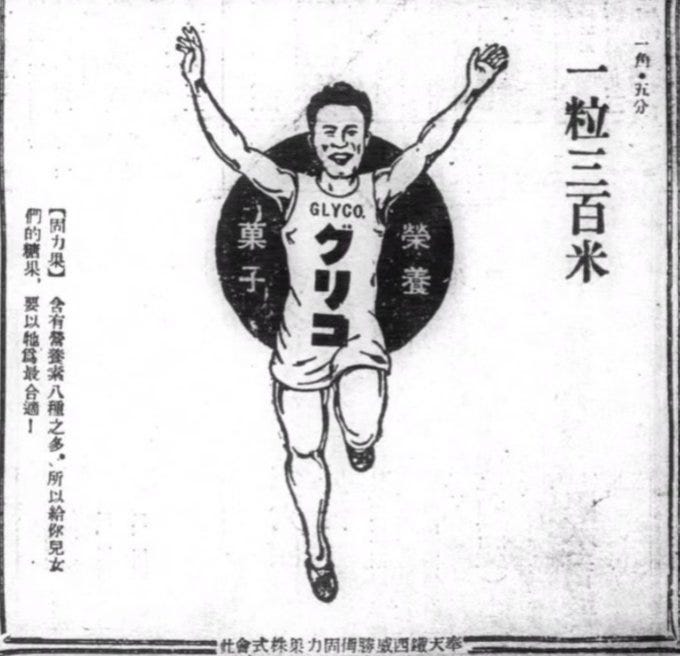
Who is Glico Man?
So this admittedly Elon Musk-y looking Asian had to be based on someone, right? Well according to Glico’s own Museum, there are three early runners that this design was based upon.
First is famed Japanese marathoner Shizo Kanakuri, who is known as the father of Japanese marathon running. He was a world record holder and all-round Japanese athletics icon.
However, his real fun fact is that he holds the record for the slowest marathon ever. Clocking in at 54 years, eight months, six days, five hours, 32 minutes and 20.3 seconds, he competed in the 1912 edition of the Summer Olympics.
Held in Stockholm, Sweden, the key part of this Summer Olympic marathon ended up being the “Summer” aspect. It was a Swedish heatwave, and the organisers decided to just run with it. This was a bad decision.
People started dropping out, with even a poor Portuguese runner collapsing. 25km in, Kanakuri decided that he wanted no part of this and joined a Swedish garden party that was occurring nearby. Meanwhile the race continued, and Shizo Kanakuri had no intention of running again. Nor letting the race officials know. So he was known as the disappearing Japanese runner.
At the garden party, he was just a new guest who stayed for an hour drinking orange juice. Years, specifically just under 55 years later, a Swedish television crew tracks the 76 year old grandparent down who by then was working as a teacher in rural Japan. They offer him the chance to complete the race, and thus complete this fun fact. Of course, this tangent would not be over without some more orange juice in the same garden villa.
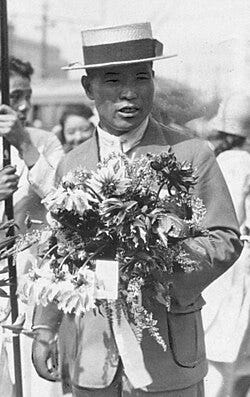
So, that was one Glico Man. The other story is more for the Filipinos. In my opinion this is where the original “Musk-ness” started since the man above does not look too 1920s Glyco to me.
Filipino Fortunato
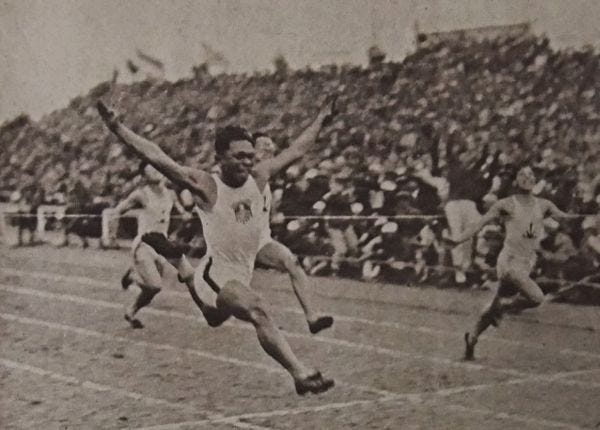
So the other story is really just one which appeals to the island nation of the Philippines. As you can see, this smiling gentleman, Fortunato Catalon, is smiling. If you look carefully, he bears a close resemblance to Mr Glyco Musk, first pictured. Even the pose was something that Fortunato was famous for, typically closing out his races with outstretched arms, remniscent of an Osakan brand legend. It isn’t entirely surprising that his pose would be used by others; Catalon was known as the fastest man in Asia.
So Glico has told everyone that they drew inspration from both men. From Fortunato they found his smile, clothing and pose. And from Kanakuri, his endurance, love of orange juice and maybe most importantly, his Japanese ethnicity.
As decades have passed, the image of Glico Man has changed. Lights have been added, his hairstyle now modernised. Yet he still towers over Osaka to remind them that energy and health are important, and Glico can help provide both!
For further Glico history, next week we will investigate one of the most famous crimes in Japanese history…
Fun history to that sign! We used to sit on the street around there on summer evenings and watch the sign and the people.
I read that they retired the original "Elon" looking Glico man because people complained that he scared children, and no child would accept candy from such a man.
Well. Not sure it's true? But I guess it makes sense.
They should have given Kanakuri a lead medal.