
Picky Pocky
What's Brown and Sticky?

Today’s article deals with everyone’s favourite stick-based treat. I knew of this product long before I stepped foot in Japan. I might have even known about Pocky before I knew what Japan was. For me, Pocky was a childhood treat that people seemingly appeared with to share with me; Pocky was chocolate brown and tasted like happiness.
So what is behind this one stick?
Starting Stick
In the beginning there was no Pocky. There was only Pretz. Actually, there was a time even before Pretz.
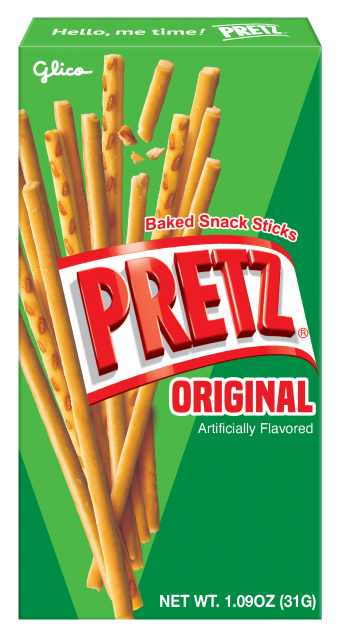
So this story starts with the invention of Pretz. Made by Ezaki Glico, a snack company in Japan that started off manufacturing those caramel candies that your grandad likes, which you secretly like too. It is 1963. Pretz is the new innovation: a savory baked biscuit stick. Named for the portable German bread thing, this was an instant hit. The trick wasn’t inventing sticks out of bread. It was in the accessiblity. Now you could have that pretzel-like butter bread away from the German bakery. It didn’t even require the curly shape. This was a miracle product that transformed Glico and soon the world. Now you could carry your breadsticks out of the house. Yes, 1963 was a time where portability first entered the unflavoured breadstick market.
In spite of this success, something nagged at the food engineers over at Glico. They must have tossed and turned. Until the eureka moment.
“What if we took Pretz… and dipped it in chocolate?”
Combine the portability of Pretz with flavour?! Alas, this idea flew too close to the sun. Testing revealed that it was not practical. Mankind could not eat chocolate without it melting all over hands. No one could abide chocolate covered phalanges, even if it allowed chocolate covered breadsticks. The world would have to wait.
You Can Handle the Chocolate
Yet the cogs kept turning over at Glico. Somehow they knew that the chocolate and bread combination was a winner, even beyond the current unflavoured business they had.
Inspiration would strike again at Glico to create Pocky. Like Thetis dipping her son Achilles into the river Styx, leaving him invulnerable to the world, Glico scientists realised that they could dip only partially into chocolate and have hands invulnerable to the melt.
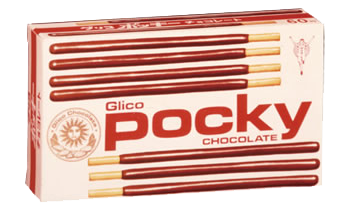
Leaving just one-third (or less) bare breadstick, nature had its own handle. The original Pocky design was born that day. Almost 3 years after their forefather Pretz, this would be the rise of a new two-tone legend.
Now they needed a name. The Glico team wanted something short, catchy, and friendly. This was not to be ChocPretz or another riff on their existing line. They must have known that this would be something that would outshine what came before. They landed on Pocky, as you know. Maybe what you didn’t know is that this is derived from pokkiri (ポッキリ), the Japanese onomatopoeia for the crisp snappy sound when you bite into crisp snappy things.
Pocky was ready to launch. Glico knew they had a hit and with 1966 arrived the long awaited… plain chocolate. It was an instant sensation. Stylish and cool, the partial chocolate dip wasn’t just practical, but quickly became iconic. No one had seen anything so simple and elegant. Brown and bread. People saw Pocky being eaten and knew instantly what it was. The portability made it perfect for eating on the go. Everyone wanted a pack and there was much more to go.
Pocky People
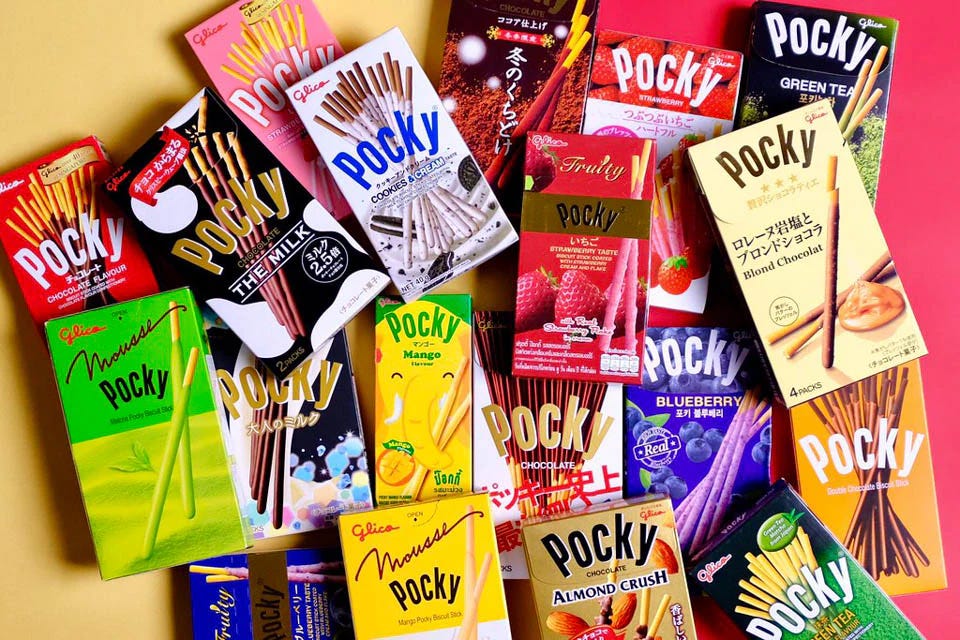
By the turn of the decade, Glico wanted even more than plain chocolate. They saw more chances of flavours now that the dipped technique was a hit. Almond rolled out at first. Then another 5 years on, strawberry. It was already a household name by now in Japan, a regular in roadtrips, study breaks, and children’s lunchboxes. It was beloved and the packaging even became a popular accessory of women’s fashion at the time, at least according to Glico themselves.
In my mind, the innovation might have slowed a bit. Not their fault; where else is there to go after the breadstick handle? Yet during these high sale, limited new product years, Glico were presented with an unexpected free marketing campaign that was never made official.
It is the late 1970s or early ’80s (the time was not entirely documented), Japanese teens began a game with Pocky sticks. Two players. One Pocky. Each bite opposing ends of said stick. Each nibbling toward the middle. If you pull away first, you lose. If not, well, game’s over, Pocky stick is eaten, oh and a kiss.
This game persists beyond just those early Pocky days. It spread everywhere first in real life through schoolyards and secret games. Nowadays it is still omnipresent in Japanese culture and even beyond. Now it is much more easily observed through the digital world of Tiktok challenges, Japanese, Korean even Filipino drama shows, anime clips, and band/cast interviews. The game has kept Pocky hyper relevant over decades among their classic young confectionary target market.
Glico still has never officially endorsed the game. Yet this game made Pocky became a more than just a classic snack and into a prop in every cheesy drama.
Air Pocky
I may have touched on how Pocky has now gone outside of just the Japanese market. While it is fair to suggest that the taste and general quality of the product has made it a hit overseas, Glico also incorporated some lessons from their launches in Japan and from the viral Pocky game.
Their first big hit outside of Japan was in Southeast Asia. Launching there, Glico quickly realised that only chocolate, almond and strawberry wasn’t going to cut it. Local tastes demanded tropical varieties. This forced Glico to try new varieties that weren’t as vanilla as chocolate or almond. Soon there was mango, banana, coconut, durian and more. These new markets meant other trials too, beyond flavour.
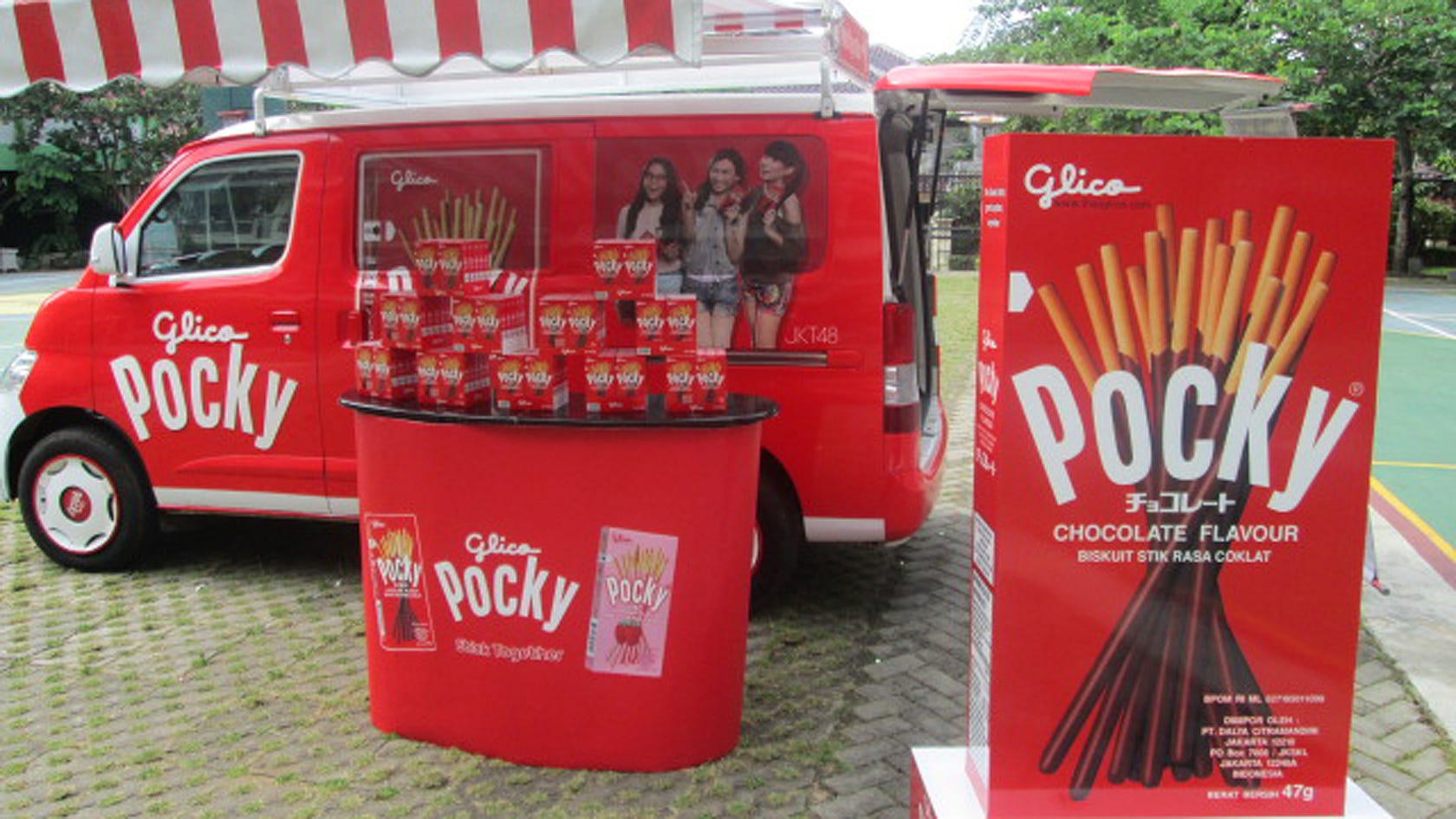
Smaller, cheaper packets were rolled out, instead of the previously one size fits all approach in Japan. These still were sold in packages as Glico felt that a core component of the snack was sharing. Instead, the company tried new marketing strategies. Indonesia became a testing ground for Glico’s “Pocky Wagons” in 2012, that became its own mini institution in Southeast Asia and Japan. These branded vehicles traveled the country to hand out free packs to school aged kids during schoolyard breaks. This has become a massive event for students, getting them to become loyal customers and definitely does not echo any tobacco industry tactic.
China became another key market, with marketing that emphasised the typical local brand and celebrity tie ins. Yet the biggest campaign that resonated in China was Pocky Day. On 11/11 every year, the country has celebrated Singles Day. More or less this is a giant selling holiday, with the digits 11 looking like single people. Pocky was able to capitalise on that existing mass buying frenzy by partnering with e-commerce giants to sell Pocky gift boxes during “Singles Day” (11/11), and re-titling it as Pocky Day with the 1’s now symbolising the iconic stick.
Admittedly, Pocky has not been as big in the West. More a staple mostly of the broader Asian diaspora, the brand hasn’t gotten the same mass market share across the pond(s). In Australia, USA and Europe, it’s hard to find more than just the generic flavours of chocolate and almond, and mostly in the aisles of Asian specialty stores. Perhaps its mild rarity has allowed it to hold extra meaning beyond just snack.
Ubiquitous in Asia and rarer outside, the treat still brings that same feeling of discovery and crisp snappy pokkiri texture. For many, it is one of those rare treats that transports you back to childhood. Food innovation made Pocky the snack it is. Yet it is thanks to its assosciation with Japanese high school culture, the sharable aspect, and the regional specialisation, that Pocky is now an icon. We all like what Pocky symbolises. So whether you have nostalgia for the 1960s chocolate version or want to try modern multiflavoured sticks, go out, get a pack and share with a friend. You don’t even need to play the Pocky game.
Not really a fan, but if I have to eat that stuff, I go for TOPPO instead.
Don’t like Pocky much, except the matcha flavor — but I love the local varieties of Pretz, my favorite being the Giant Mentaiko Pretz that you can get at Hakata station.