
Sudoku's Productivity Rival
Mandala Chart or was it Mandela Chart

There are a myriad of Japanese productivity how-to guides out there. While I’m not here to tell you how to spark joy or find meaning in your life, I will share how you can become the greatest of all time in your field.
Let me introduce Japan’s favourite chart to for life planning.
Build your own Mandala
So what is this chart?
Visualise a 9 x 9 box. Within each section of the smaller 3 x 3 boxes, highlight the middle box. Then with your middle 3 x 3 box, you’ll have a central box.
Actually maybe it’s easier if I just show you.
Below is a Mandala Chart (mandalart) sketch made by a 15 year old highschooler. These ones are no doubt commonly organised in these sort of early teen years by frustrated teachers that want to encourage the future leaders of society.
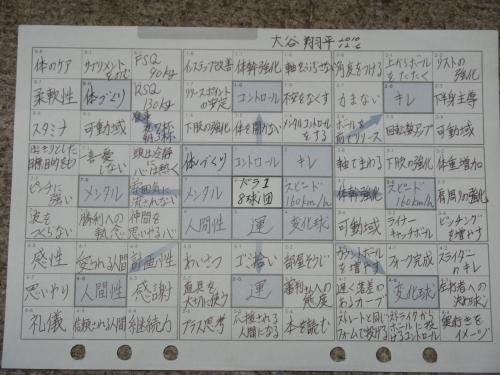
For me, this still looks confusing. It could be that my Japanese language skills are still too basic to read pixellated high-schooler handwriting, or that there seem to be many colours and lines that correspond to various items.
So you see that it is a goal setting thing with a central goal with other related goals goals. I’m still not making much sense. Maybe I’ll get a translation up of this board.
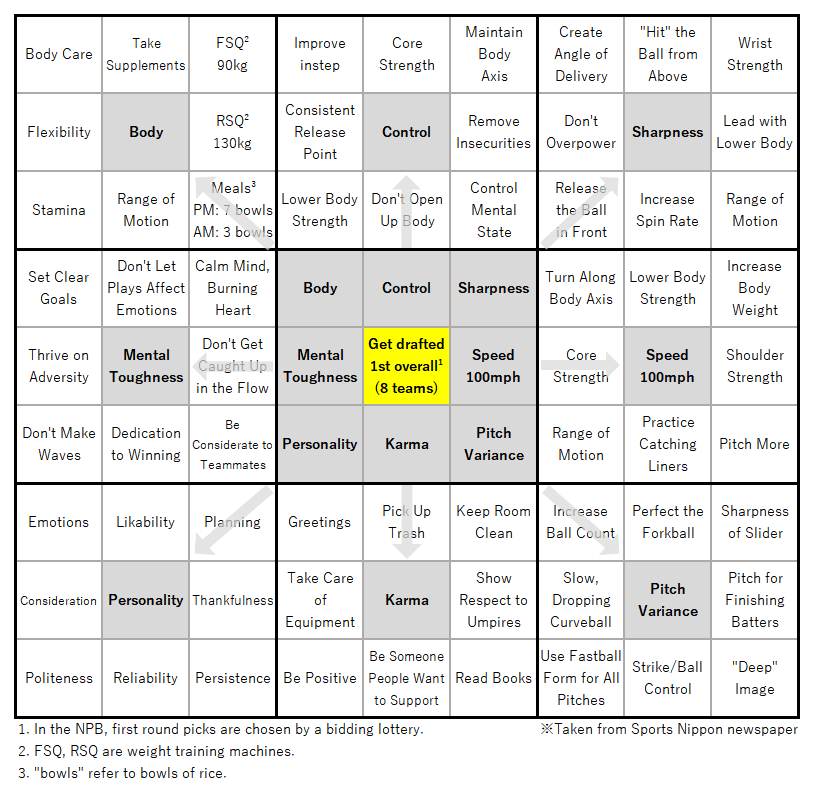
Let me preempt a few questions. The above chart is someone retyping the Mandala Chart of the original highschooler board. If you now read it, it seems very… what’s the word? “Baseball-centric”. In fact, this Mandala Chart was discovered a few years ago and is a Japanese baseballer’s high school aspiration. Yes, it is that person that all of Japan has obsessed over at least since COVID.
Shohei Ohtani.
What does Shohei have to do with anything?
Well if you haven’t been to Japan since the pre-Sho Era, let me explain a few rules.
His presence is everywhere.
To that point, he endorses everything.
Everyone knows what he’s been up to.
People cannot get enough of him.
In all fairness, he is very likely the greatest baseballer ever, coming from a country that is obsessed with baseball. Thus, his entire childhood has been looked at, from childhood home, to Koshien stats, and of course his Mandala Chart.
His particular Mandala Chart has now become greatly appreciated as it seems to provide a blueprint on becoming an all world baseball legend. Your all-in-one guide. I’m not going to explain how to be good at baseball. Just read his chart. Instead, I’ll explain how to make and read this Mandala Chart, so that you can become the next Ohtani or even pursue your own dreams and passions!
Mandala Making
In terms of the history of the chart, all you need to know is that a Japanese gentlemen, Yasuo Matsumura, adapted the historic Buddhist pattern of mandalas not to achieve nirvana but for business success. It became branded as a Mandala Chart, commonly referred to as Mandalart.
What is involved?
It is basically a square-er version of concentric circles. In the very middle is the ultimate goal. This can be anything. Getting drafted 1st in baseball, drafted 2nd in baseball or even drafted 3rd in baseball. Matsumura thought that often such lofty goals have lots of component parts. Like any checkerboard, there are 8 adjacent squares.
In each of these ones, put items that count towards the bigger main goal. From the Shohei example, you can tell that reaching 8 total subgoals for each is a bit of a stretch. Often you’ll get to 6 or 7 (⁶🤷⁷), then you start reaching for stuff like “being a good person” or “life improvement”. I personally don’t know if this impacts your baseballing skill, otherwise every garbage person would be a number one draft pick. That’s ok. Treat this as a nice visualisation tool instead of actually building a life around this. It might make it easier.
The final part is doing the same thing for each connective piece. From your 8 component parts of your bigger goal, you will now need to find an additional 8 ways to improve each of these. Soon you’ll be drawing away and have a magical Mandala in front of you.
In total you have 1 big goal, then 8 sub goals, and 64 sub-sub goals. Which, broken down, is a lot to get through. This technique should make it less daunting than that sounds. I suppose all these life hacks and improvement things are nifty ways of making the big achievement bite sized. For some, this could be a way of helpfully working out how to tackle an otherwise vague goal. For others, this might just pose a further obstacle, with some probably thinking “Now I have to make a chart as well!”.
I don’t want to muddy the waters by suggesting that with this one hack, you too can act like an adult. I’ve gone through many failed productivity measures in some attempt to get through the mundanity of everyday work and existence. This might solve nothing or everything. Maybe even something in between.
Whether or not you give it a go is up to you. The main goal of this article is to have people enjoy the writing; anyone deciding to implement Mandalart is just an unexpected perk for me. This may be another Ohtani-endorsed product that gets embraced, or you might think that this 1980s business productivity manual should stay in its decade.
What stayed with me was the tension between breaking a vague goal into smaller parts and suddenly creating 64 new obligations. I appreciate that you did not present Mandalart as a magic productivity fix. The chart seems most useful when it reveals missing parts of a plan, rather than becoming another plan to maintain.
Loved the conclusion 😆