
Red Shirt Blue Shirt
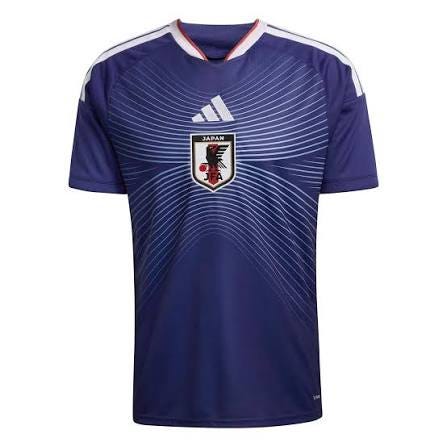
Why does Japan play in blue

As a colour-blind person, I often find it hard to directly answer colour-based questions. But this hasn’t been an issue with identifying the Japanese national team for football. Yes, today’s article will be joining the World Cup coverage with a pretty straightforward question.
Why Blue?
Most teams play in a colour that speaks to the national identity, that is normally found in the flag colours. This is not the case in Japan. In case you missed it, Japan has a flag with two very not-blue colours: white and red.
I’ll start at the very beginning. The reason different teams wear different colours when playing sports is to distinguish their teammates against the opposition. This was one of the first things anyone when designing a sport with rules liked to do, so that there would be as little confusion as possible.
Symbolise this
At the national level the team colours get decided by the national football association. While many colours are iconic now, they were all selected at some point to symbolise something about national identity. Even the most famous kit, the Brazil yellow, was not even their team colour during the early iterations of the World Cup. Instead they played in white and blue. It was only after they had a nationally devastating loss at home in 1950 that the Brazillian Football Association decided that they couldn’t continue with this colour scheme and eventually switched to the iconic yellow.
Japan was no different. Not that they had a devastating footballing loss in 1950 but that the Japanese Football Association (JFA) chose the colour. The time is 1921. The JFA is founded. Since it is a pretty new sport with a pretty new association, things weren’t that formal. The JFA was basically just uni students trying out. So they choose the national team colour based on whatever the uni team shirt colours were. Since the University of Tokyo was the best uni soccer team at the time, they used their colour of light blue.
Thus blue Japan was born.
Colouring the University
We must go deeper. Why does the University of Tokyo wear light blue?
One year earlier. 1920. The University of Tokyo and University of Kyoto thought that Britain was cool and fun. I mean the actual names of the Universities in 1920 was Tokyo Imperial University and Kyoto Imperial University, so the British Empire had some cachet. In particular they wanted to copy the British boat race. Oxford vs Cambridge but in Japan.
So the race was ready, with two boats. Light blue and dark blue. Neither university had a preference, so they drew lots or basically flipped a coin. History was made as Tokyo was allocated the colour of light blue, representing the University of Tokyo ever since.
The random chance that there were two blue boats on a river for rowing became the groundwork for the national look of Japan football a century on. Yet even after this goal, red would lurk.
Red redemption?
In any country there are reds that live amongst us. Reds under the bed. For Japan, the red faction would have a spell of dominance in the 1980s. They made the admittedly not unreasonable case that Japan’s national kit should have something to do with the Japanese colours of white and red. The coach Kenzo Yokoyama was keen to have Japan finally represented by colours they were used to. A point of national pride, Japanese red would be seen the world over.

This was meant to be the return to a consistent colour identity. Why then do we not see Japanese teams play in red anymore?
Well there wasn’t much of a statement on the world stage. Japan’s football team failed to qualify for the 1990 World Cup, so no one got to see this new look. Then sensing a chance for change and another opportunity to showcase their wardrobe, they also failed to qualify for the 1992 Summer Olympics. Fans blamed everyone and everything. Most of all this stupid idea to have red kits. This red kit era is known as a cursed period among Japanese football fans, so it is truly a red card for the red shirt.
Blue’s back
The JFA had to go back to the reliable blue. Since then, Japan has built their footballing identity closely with the colour. It was helpful as well for international commentators that Japan play in such a bold blue. With other major Asian teams playing in red such as South Korea, North Korea, China, etc., they didn’t need another obstacle in distinguishing the countries. So Japan has coloured themselves blue.

The now official title of the national team was voted as Samurai Blue in 2009, completing that blue victory. The colour was darkened to match the kachi-iro indigo, which was meant to be worn under the Samurai armour. Kachi, meaning victory, also works as thematic wordplay. Further efforts of making this lore stick include invoking that blue somehow represents the bushido code, and of course Blue Lock helped cement this as the national footballing colour. Let me know if you’d like to hear more about Blue Lock in the comments.
While the colour may have originated from having a university boat race, what they represent now is far greater. This blue jersey carries with it the pride and hopes of 100 million fans. So as Japan hopefully progress far into this tournament, remember that this would not be possible if they played in red.
Incredible insight and deadpan delivery amigo - thank you. I know nothing about Blue Lock, so yes would like to hear more, especially if it’s World Cup related.
May the squad indeed continue their march to eventually World Cup 2050 victory 🔵